House Deposit in Working Hours: Every Area Ranked (2026 Study)

In Kensington and Chelsea, a 10% house deposit costs 4,520 hours of the borough's own median wage: every penny of nearly two and a half years of full-time work. In Burnley, it costs 776 hours: about five months.
That is the finding of this study, which does something the usual affordability tables don't: it divides each area's local house price by that same area's local pay. Most rankings divide local prices by the national average salary, which makes London look survivable (everyone earns more there, right?) and the North look easier than it is. Joining HM Land Registry prices to ONS earnings for the same 307 local authorities tells the real story.
At a glance
- Worst area
- Kensington & Chelsea: 4,520 hours
- Best area
- Burnley: 776 hours
- Median area
- 1,511 hours (~40 weeks)
- Deposit beats a year's work in
- 55 of 307 areas
Key Takeaways
- The gap between the easiest and hardest place to save a deposit is 5.8×: 776 hours in Burnley against 4,520 in Kensington and Chelsea.
- In 55 of 307 areas, a 10% deposit costs more than a full year of median full-time work (1,950 hours): even if every penny of gross pay went to it.
- Higher London wages do not close the gap. Local pay varies by well under 2× across the country; local prices vary by nearly 10×.
- The median area needs 1,511 working hours, and at a realistic saving rate of 10% of pay, that is roughly 7.7 years.
- All 32 London boroughs sit above the national median. The ten easiest areas are all in the North of England and South Wales.
Find your area
Search the table, or sort by hours, price or local pay. Every figure is your area's price against your area's wage.
⏱️ Every area, local price ÷ local pay
| # | Area | Weeks | |||
|---|---|---|---|---|---|
| 1 | Kensington and Chelsea | 4,520 | 121 | £1,255,567 | £27.78/h |
| 2 | Hammersmith and Fulham | 3,107 | 83 | £729,407 | £23.48/h |
| 3 | City of Westminster | 3,090 | 82 | £836,331 | £27.07/h |
| 4 | Camden | 2,967 | 79 | £805,837 | £27.16/h |
| 5 | Elmbridge | 2,850 | 76 | £750,157 | £26.32/h |
| 6 | Richmond upon Thames | 2,757 | 74 | £788,872 | £28.61/h |
| 7 | Brent | 2,716 | 72 | £548,895 | £20.21/h |
| 8 | Ealing | 2,697 | 72 | £568,887 | £21.09/h |
| 9 | Haringey | 2,647 | 71 | £633,853 | £23.95/h |
| 10 | Islington | 2,535 | 68 | £669,879 | £26.43/h |
| 11 | Three Rivers | 2,474 | 66 | £576,942 | £23.32/h |
| 12 | Barnet | 2,460 | 66 | £590,583 | £24.01/h |
| 13 | Sevenoaks | 2,451 | 65 | £553,752 | £22.59/h |
| 14 | Hertsmere | 2,427 | 65 | £562,261 | £23.17/h |
| 15 | Wandsworth | 2,423 | 65 | £659,547 | £27.22/h |
| 16 | Windsor and Maidenhead | 2,418 | 64 | £584,743 | £24.18/h |
| 17 | Chichester | 2,417 | 64 | £436,312 | £18.05/h |
| 18 | Hounslow | 2,402 | 64 | £501,326 | £20.87/h |
| 19 | Hackney | 2,371 | 63 | £608,470 | £25.66/h |
| 20 | Mole Valley | 2,322 | 62 | £540,643 | £23.28/h |
| 21 | Epping Forest | 2,316 | 62 | £535,682 | £23.13/h |
| 22 | Brentwood | 2,310 | 62 | £530,088 | £22.95/h |
| 23 | Southwark | 2,301 | 61 | £578,683 | £25.15/h |
| 24 | Harrow | 2,298 | 61 | £530,021 | £23.06/h |
| 25 | Kingston upon Thames | 2,297 | 61 | £582,403 | £25.35/h |
Hours = a 10% deposit on the area’s average price (May 2026, HM Land Registry) divided by the area’s median full-time hourly pay (2025 ASHE, ONS), gross: as if every penny of every worked hour went to the deposit. Real saving takes several times longer. Weeks assume 37.5 paid hours.
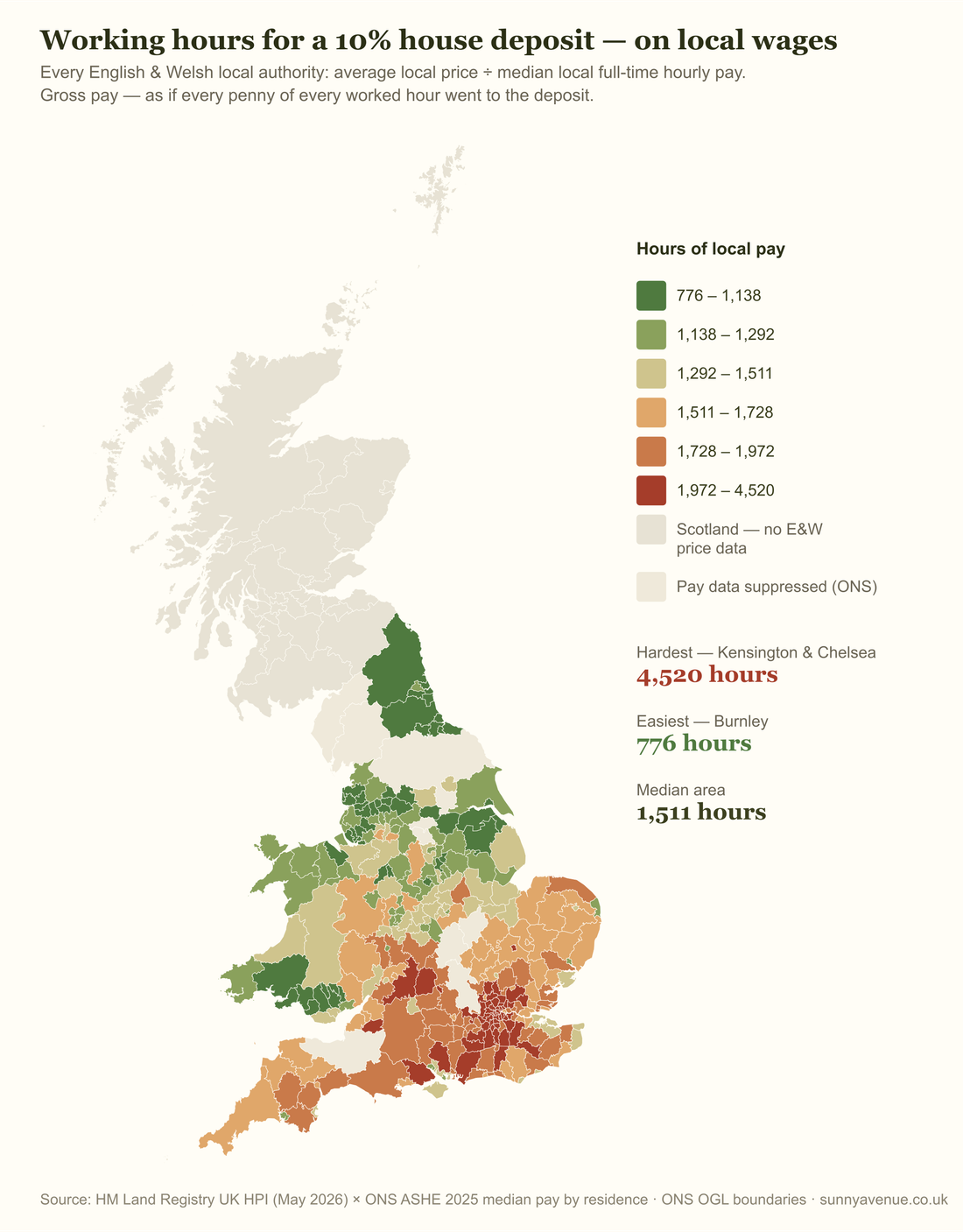
The ten hardest and ten easiest
The hardest ten are London and its commuter belt, with Elmbridge in Surrey the only non-London entry in the top six. The easiest ten split between the North East, Lancashire, Hull and the South Wales valleys.
| Hardest | Hours | Easiest | Hours | |
|---|---|---|---|---|
| Kensington & Chelsea | 4,520 | Burnley | 776 | |
| Hammersmith & Fulham | 3,107 | Blaenau Gwent | 793 | |
| Westminster | 3,090 | Middlesbrough | 809 | |
| Camden | 2,967 | Hartlepool | 815 | |
| Elmbridge | 2,850 | County Durham | 823 | |
| Richmond upon Thames | 2,757 | Hull | 825 | |
| Brent | 2,716 | Hyndburn | 829 | |
| Ealing | 2,697 | Darlington | 838 | |
| Haringey | 2,647 | Blackpool | 843 | |
| Islington | 2,535 | Merthyr Tydfil | 843 |
Why higher wages don't save London
The intuition is that London prices are matched by London pay. The data says otherwise, and the reason is simple arithmetic: pay is compressed and prices are not.
Median full-time hourly pay in Kensington and Chelsea is £27.78. In Burnley it is £16.71. That is a gap of 1.7×. But the average home in Kensington costs £1,255,567 against Burnley's £129,643: a gap of 9.7×. Wages cannot stretch far enough to cover a price gap five times wider than the pay gap, so the hours pile up wherever prices are high, regardless of what the neighbours earn.
Brent makes the point sharply: its median hourly pay (£20.21) is below the London average, but its prices are London prices, so an ordinary earner there faces 2,716 hours, seventh worst in the country.
The median London borough demands 2,297 hours; the median authority outside London, 1,452.
What "hours" really means here
The hours figure is deliberately a fantasy: it assumes every penny of gross pay (before tax, rent, food, everything) goes into the deposit. Nobody can do that. It is used because it is the cleanest way to compare areas, immune to assumptions about tax bands, rents or lifestyles.
A more realistic benchmark: saving 10% of gross pay, the median area's 1,511 hours becomes roughly 7.7 years of consistent saving. In Kensington and Chelsea it becomes over 23 years, which is why almost nobody buys there on a median local wage, and why the salary you actually need matters more than the average one.
If you are working out your own numbers, our deposit-in-working-hours tool does this calculation for your own wage and target home, and the affordability calculator turns it into a realistic budget.
Method and sources
- Prices: HM Land Registry UK House Price Index, average price by local authority, May 2026. England and Wales only, which is why Scotland and Northern Ireland do not appear.
- Pay: ONS Annual Survey of Hours and Earnings (ASHE) 2025, median gross hourly pay excluding overtime, full-time employees, by residence, so the wage describes the people who live in the area, not those who commute into it.
- Join: the two datasets are matched on ONS GSS codes. 307 of 317 price-tracked authorities matched; the ONS suppresses pay estimates for a few small areas where the survey sample is too thin.
- Deposit: 10% of the area's average price. Hours: deposit ÷ local median hourly pay. Weeks: hours ÷ 37.5.
This page and its data are free to cite with a link. The underlying table updates when new HPI or ASHE releases land.
Frequently asked questions
How many hours do you need to work to afford a house deposit in the UK?
In the median English or Welsh local authority, a 10% deposit costs about 1,511 hours of median local full-time pay, roughly 40 weeks, if every penny of gross pay went to it. At a realistic saving rate of 10% of pay, that is closer to eight years.
Where is a house deposit easiest to save in the UK?
Burnley, where a 10% deposit on the average home equals 776 hours of local median pay: about 21 weeks of gross full-time work. Blaenau Gwent, Middlesbrough, Hartlepool and County Durham complete the top five.
Where is a house deposit hardest to save?
Kensington and Chelsea: 4,520 hours of the borough's own median wage, or roughly two years and four months of every gross penny. Hammersmith & Fulham, Westminster, Camden and Elmbridge follow.
Doesn't higher London pay make up for higher prices?
No. Median full-time pay varies by less than 2× across England and Wales, while average prices vary by nearly 10×. All 32 London boroughs sit above the national median for deposit hours despite paying the country's highest wages.
What deposit does the study assume?
10% of the area's average price, which is the common first-time buyer benchmark. A 5% deposit halves every figure in the table; a 15% one adds half again: the rankings do not change.
General information only, not financial advice. Speak to a suitably qualified, FCA-authorised professional before acting.