Pensions
A Pension is a savings vehicle geared towards providing you with an income or lump sum upon retirement. Pension plans are a tax-efficient way to save money for long-term purposes.
Key Takeaways
- Pensions are Tax-efficient ways to save for your future
- There are tax options for the self-employed as well as workplace pensions provided by employers
- if you contribute at least 10 years worth of National insurance you will be entitled to a state pension, which is only £185.15 weekly
- It's important to start saving early and review regularly
- You are able to transfer your Pension in order to find a more suitable product for you
A Pension is a savings vehicle geared towards providing you with an income or lump sum upon retirement.
What are Pensions?
Pension plans are a tax-efficient way to save money for long-term purposes.
Most people in the UK are entitled to a state pension if they have contributed enough towards national insurance. However, living off of state pension income alone may not be enough.
The question isn't at what age do I want to retire; It's at what income?
Who can arrange a Pension for you?
In the UK, Pensions can be arranged through employers. This type of pension is known as a workplace pension. Employees are usually auto-enrolled for this type of Pension.
Another pension type, known as a Personal Pension, can be arranged through a financial adviser or a pension provider.
To arrange a Personal Pension, you will need to proactively make contact with an adviser to assist you.
When can you take your Pension?
Upon age 55, you are able to claim the funds saved, plus any growth. The UK government entitles you to a tax-free lump sum of 25%. If you decide not to take a lump sum, you can purchase an Annuity.
An annuity is an agreement to receive a fixed regular income until death, in exchange for all or part of your pension pot.
Why pay into a Pension?
Even though retirement can feel quite far away for most people. It's never too early to start planning. It's important to consider what your outgoings may look like and how you will afford to maintain the lifestyle you would want to have.
If you fail to plan appropriately for retirement, you may not be able to achieve your retirement goals. That could mean missing out on valuable time you have in later life.
You will want to have a plan in place that will allow you to live comfortably as well as handle any unexpected bills that may occur. Such as dental or medical fees.
How many Pensions can you have?
You can have as many pensions as you require - and this can sometimes be a problem for people, as they often forget about old pensions and who provided them! Keep a note of the providers. You will thank yourself when you're ready to retire.
Are there limits to paying into a Pension?
There are limits on how much you can invest into your pension every tax year and also over your lifetime. The annual allowance for 2022/23 is £40,000.
The allowance applies across all of your pensions and not per pension.
The lifetime allowance in 2022/23 is £1,073,100. The lifetime allowance also includes any growth through the performance of the investments. That means it includes total contributions, growth, and any tax relief.
What are the types of Pension?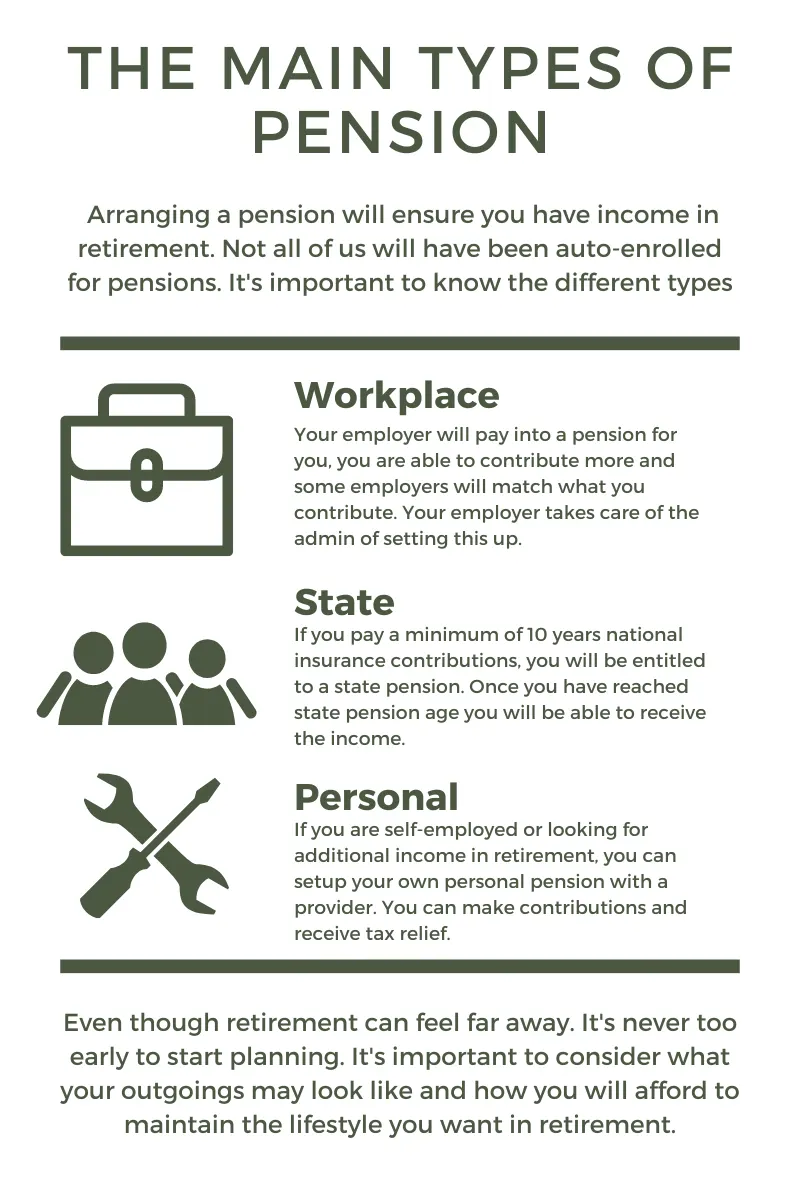
Workplace Pension
The most common type of pension is the Company pension. One which is provided by a workplace. Also known as a Workplace pension.
Your employer must auto-enroll you into a pension scheme and make contributions if you are eligible for auto-enrolment.
To be eligible you must be older than 22, younger than the state pension age, earn at least £10,000 per year and work in the UK.
Most UK companies will auto-enroll you for the company pension scheme as soon as you begin working for them, irrespective of age. However, it is a legal requirement now for companies to offer a scheme should you meet the above auto-enrollment conditions.
One of the benefits of having a company pension scheme is that the company may match your pension contributions.
For example: If you pay 5% of your salary to your pension pot, they may match this by paying in an additional 5%, giving your pension pot a contribution total of 10%
Personal Pension
The Personal Pension is sometimes referred to as a private pension.
Those who do not have a company pension, such as the self-employed, may pay into a personal pension, as well as anyone else looking to raise more money for their retirement. Personal pensions are available to anyone and there is no requirement to be self-employed.
The personal pension contributions are invested for growth with the intention of providing a lump sum or annuity upon retirement age.
State Pension
The State Pension is provided by the Government and the amount you are entitled to will depend on the number of years of national insurance contributions you have made.
You need to have contributed at least 10 years of national insurance contributions to receive a state pension. To receive the full amount available you need to have contributed for 35 years. If you have paid for a number of years in between you will receive an amount based on how many years you have contributed.
State pension entitlement works on a scale. The more years you have paid, the more state pension you will be entitled to.
The current state pension is £185.15 a week, (£9,627.80 per year). The amount has been rising annually based on factors such as inflation.
The age you are able to claim the state pension depends on when you were born. If you were born before April 1959, you will receive your state pension at 66. If you are born after 5th March 1961, you will be entitled at age 67. Finally, if you are born after 5th April 1978, the current age is 68.
Rules can change, there is a State Pension Age calculator available on the government website.
Pension Transfers
Pension transfers allow you to combine many of your pensions into one.
By transferring Pensions, you can make your pension management easier and clearer to follow. You will be able to take control of what fees you pay and reviewing your pensions may even result in fewer annual charges.
You might want to move your pension if:
- You are changing jobs
- Your pension scheme is being closed
- You have pensions with multiple providers and you want to bring them together
- You're moving overseas and want to move your pensions to that country
If you are moving overseas you need to be aware of your pension options.
What is a QROPS?
A QROPS (Qualifying Recognised Overseas Pension Scheme) pension transfer is the process of transferring a pension from a UK pension scheme to a pension scheme located in a different country that is recognised by the UK government.
If you do not use a QROPS when transferring abroad, you may be liable for tax on your pension income and lose the benefits of your UK benefit that the government allowed.
You can get independent advice from a Financial adviser regarding your pensions.
Financial Advisers will review the performance and charging structure, making a recommendation on whether you should consider completing a transfer. If you do proceed, they will assist you with the administration behind that.
What is a Pension Transfer?
A pension transfer is when you move your pension from one provider to another. As you approach retirement you may want to consider moving your pension if another provider can offer you a higher annuity or other benefits.
Is it a good idea to transfer my pension?
It's important to review your options upon retirement and obtain a full pension review. This will allow you to understand the full details about your options and whether you are on track to retire. It will not always be the case that you are better off transferring your pension. You should seek advice from a Financial adviser around this.
How does a pension work?
Workplace pensions allow your employer to contribute to your retirement fund. You can also contribute, as a tax efficient money sacrifice directly from your salary. This means you do not pay income tax on the funds you sacrifice to your pension. This money is then invested accordingly into the stock market in certain global funds and units, chosen by your provider. You should seek regular pension reviews and upon retirement or minimum age 55, you will be able to claim your funds with up to a 25% tax free lump sum.
Do you lose your pension if you quit?
No, you will not lose your pension. However, all contributions will stop, including those from your employer. Your funds will continue to be managed by the pension provider. You can opt to freeze it if you wish. Freezing a pension means it stays as cash until you are ready to retire.
Am I too old to start a pension?
After age 55, you can claim your pension funds whenever you choose to, so it really never is too late to start a pension.
What can an Adviser do for my pension?
Seeking financial advice around your pensions will allow a qualified professional to review your retirement goals, the current performance of your pension, as well as the fees being charged. It may be that some of this information you are unaware of and sitting down with a financial advisor will help you to plan accordingly. Financial advisers are able to move pensions to different providers if they fit your needs better.
How do I find my old pensions?
First step is to contact your previous employers and ask them for the details of the pension provider during the period you worked at the company. If this doesn't work out, there is a government pension tracking service. It’s a free service that searches a database of over 200,000 personal pension and workplace schemes. https://www.findpensioncontacts.service.gov.uk/
How much of my pension can I take out at 55?
You are able to withdraw the full value of your pension in one lump sum. You will receive the first 25% tax free and pay income tax on the remainder. Seeking advice will help you decide the best, most tax efficient way to withdraw your funds.